
What Happens If You Don’t Replace an Extracted Tooth? The Long-Term Effects
By Dr. Namratha Umesh
Founder – Dental Conceptz
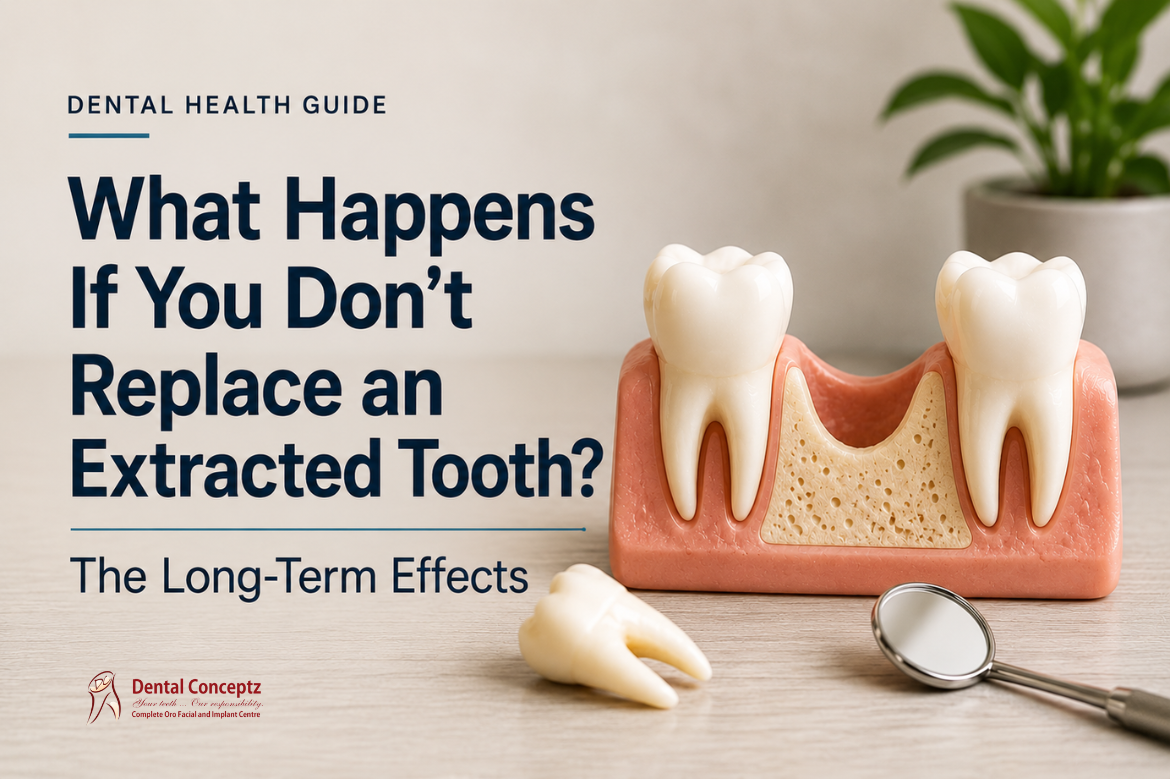
Most people feel relieved the moment a painful tooth finally comes out. The infection is gone, the ache has stopped, and life feels considerably more comfortable than it did 48 hours ago. But then the question that every dentist will ask and that many patients quietly push to the back of their mind is what comes next. Do you actually need to replace an extracted tooth, or can you leave the gap and move on? It’s a question worth taking seriously, because the answer affects a lot more than just how your smile looks. The long-term consequences of leaving a gap where a tooth used to be are real, progressive, and significantly more expensive to correct the longer they’re left unaddressed. This blog covers everything you need to know about missing tooth replacement, why it matters, what your options are, and when the right time to act is.
The Moment the Tooth Comes Out, the Clock Starts
Here’s what most people don’t realise: the consequences of a missing tooth don’t happen all at once. They unfold gradually — over months and years — in ways that are almost invisible day to day but add up to significant structural and aesthetic changes that become harder and harder to reverse.
The process begins immediately after extraction. Within the first few weeks, the bone that previously surrounded and supported the tooth root starts to reabsorb. Your body essentially reads the absence of the tooth root as a signal that that bone is no longer needed, and begins breaking it down and redistributing the minerals elsewhere.
This bone loss is the engine behind almost every long-term consequence of a missing tooth. Understanding it is the key to understanding why timing matters so much when it comes to tooth replacement after extraction.
What Happens to Your Jawbone
In the first year after a tooth is extracted without replacement, you can lose up to 25 percent of the bone width in that area. By the end of three years, that figure can reach 40 to 60 percent if no action has been taken.
Patients may want to get a dental implant many years after having a tooth removed. Because of the loss of bone, this can be difficult to do. All implants must have enough good, healthy bone to support them, so the loss of bone makes it necessary to have bone graft surgery before the implant can be placed. This adds time, cost, and complexity to a treatment that would have been simple if the patient had received the implant sooner.
That is why dentists emphasize the importance of solving problems related to tooth extraction as early as possible. Each month reduces the time frame for implementing a simple and affordable procedure.
The Neighbouring Teeth Start to Move
Teeth are not fixed in isolation. They exist in a balanced system where each tooth maintains its position partly because of the support provided by its neighbours. When one tooth is removed, that balance is disrupted.
The teeth on either side of the gap begin to tilt gradually into space. The tooth directly above or below the gap — with no opposing tooth to bite against — begins to over-erupt, meaning it gradually grows further out of the gumline than it should because there’s nothing to limit its movement.
These shifts are slow enough that most people don’t notice them in the early stages. But over time, the cumulative effect changes the alignment of the entire bite. Teeth that were previously straight become crowded or gapped. Bite problems that weren’t there before develop because the upper and lower arches no longer meet correctly.
The clinical term for this process is dental drift, and it’s one of the most common and frustrating consequences of what happens if you don’t replace a missing tooth. Once teeth have shifted significantly, correcting them may require orthodontic treatment in addition to the replacement procedure — substantially increasing the overall cost and timeline.
Your Bite Changes and So Does the Stress on Other Teeth
When teeth shift and the bite alignment changes, the forces of chewing are redistributed unevenly across your remaining teeth. Teeth that were not designed to absorb heavy biting force are suddenly taking on more than their share because the missing tooth is no longer contributing.
Over time, the extra load causes too much wear on some teeth, which increases the chances of them cracking or fracturing; therefore, sensitivity will also increase. Many patients who have had one tooth extracted and then left that space will eventually return to their dentist due to having multiple teeth damaged, which were perfectly healthy at the time of the extraction, and only cause the initially missing tooth to be an issue.
It is one of the most expensive and underappreciated outcomes of delayed tooth replacement treatment in Bangalore; the problem multiplies. You come in for one tooth and leave with three teeth that need attention.
Facial Structure and Appearance Change Over Time
This is the consequence that tends to surprise people most when they first learn about it, but it’s entirely logical once you understand the bone resorption process.
However, your jawbone isn’t just important in supporting the teeth. The jawbone helps give support to the bottom part of the face. As the bone deteriorates due to the absence of the tooth, the facial tissues lose some of their structure. Eventually, this will lead to a slight depression that is noticeable on the face where the gap exists.
For patients who have lost multiple teeth over time, this effect is more pronounced. The face can appear to have aged faster than it otherwise would — not because of skin changes, but because of the loss of the bony framework underneath.
This is one of the reasons why dental implants in Bangalore are considered the gold standard for tooth replacement. Unlike bridges or dentures, an implant places an artificial root directly into the jawbone, which stimulates the bone and prevents the resorption process. It essentially fools the body into maintaining the bone because the mechanical signal of a tooth root is still present.
Chewing Efficiency Drops and Digestion Is Affected
Every tooth in your mouth has a specific role in the chewing process. When one is missing, the efficiency of that process decreases. Food that isn’t adequately chewed before it’s swallowed places a greater burden on the digestive system, and patients with multiple missing teeth often unconsciously modify their diet to avoid foods that are difficult to chew comfortably.
The restriction of eating nuts, raw vegetables, hard fruits, and chewy proteins can result in long-term nutritional impacts. For people who have difficulties with bringing food to their mouths, some of the foods they choose not to eat when they cannot chew properly tend to carry a high amount of nutrients. This issue is of particular concern for older patients because their nutrition can directly affect their health and their ability to recover from illness or injury.
How Long Do You Have Before It Becomes a Problem?
The honest answer is that bone loss begins within the first few weeks, and the neighbouring teeth begin to shift within the first few months. There is no safe window of “just waiting to see.”
How long to replace an extracted tooth is a question with a clear clinical answer: as soon as you are medically ready, after the extraction site has healed, typically 3 to 6 months after a straightforward extraction. For patients with specific health conditions or those requiring bone grafting, the timeline may be longer, but the planning should begin as soon as possible.
When there is a long period of time during which a tooth gap is not filled, the complexity, cost, and time to do the eventual treatment will increase. An implant that is placed within six months after the extraction for a patient with good bone density is considered a simple procedure. However, if the implant is placed three years after an extraction for a patient with significant bone loss, then the implant will require a bone graft and longer healing times, along with being more expensive overall.
Your Replacement Options - What’s Available in Bangalore
For patients in Bangalore, there are three main options for replacing a missing tooth, each with its own advantages and considerations.
Dental Implants
A dental implant is a titanium post placed surgically into the jawbone, onto which a natural-looking crown is attached. It functions exactly like a natural tooth — in appearance, sensation, and importantly, in the stimulation it provides to the surrounding bone.
Dental implants for missing teeth are increasingly the most recommended option for patients who are good candidates, because it is the only replacement that addresses the bone loss issue directly. Well-placed implants can last decades — often a lifetime — with proper care.
At Dental Conceptz, Dr. Namratha Umesh has placed over 5,000 successful implants, with advanced training in ALL-ON-4 protocol, GBR, and sinus augmentation from Switzerland, and soft and hard tissue augmentation from Germany, Poland, Brazil, and Spain. For patients at our dental clinic in Jakkur or Sahakaranagar, the level of implant expertise on offer is genuinely comparable to international standards.
Dental Bridge
The dental bridge takes the support of the two teeth on both sides of the gap, with an artificial tooth bridging them in between. The dental bridge is a fixed bridge that cannot be removed.
The main consideration with a bridge is that the anchor teeth need to be shaped — healthy tooth structure is removed to accommodate the crowns that hold the bridge in place. For patients weighing a dental implant vs. a bridge, the implant is generally the preferred long-term solution if bone quantity and health permit, because it doesn’t involve modifying healthy adjacent teeth.
That said, bridges are a perfectly viable and effective option for many patients — particularly those who are not implant candidates due to medical history, bone availability, or cost considerations.
Removable Partial Denture
A partial denture is a removable appliance that replaces one or more missing teeth. It is typically the most affordable option but also the least natural in function and feel. Partial dentures do not prevent bone loss — they sit on top of the gum rather than integrating with the bone and require careful daily maintenance.
For certain patients, especially those with several teeth missing and those with other complicating health issues, a removable partial denture would make an appropriate temporary or even permanent option. You can ask your dentist for his recommendation in light of your case.
Why Getting This Right Matters in the Long Run
The decision to replace an extracted tooth is not a cosmetic one. It is a health decision with long-term structural, functional, and financial consequences. The cost of inaction in terms of bone loss, neighbouring tooth damage, bite problems, and the complexity of eventual treatment, almost always exceeds the cost of acting promptly.
At Dental Conceptz, with clinics in Sahakaranagar and Jakkur Layout, Bangalore, Dr. Namratha Umesh and her specialist team work with every patient to understand their specific situation, their timeline, and their budget — and recommend the replacement option that makes the most clinical sense for their long-term oral health. There is no one-size-fits-all answer, and there is never any pressure—just clear, honest, expert guidance from one of Bangalore’s most experienced implantologists.
FAQ
1. What happens if you don't replace a missing tooth?
The jawbone shrinks, nearby teeth shift, and your bite can become misaligned over time.
2. How soon should you replace an extracted tooth?
It's usually recommended within 3–6 months after healing to reduce bone loss and tooth movement.
3. What are the best options for replacing a missing tooth?
Dental implants, bridges, and partial dentures are the most common options. Your dentist can recommend the right one.
4. Is a dental implant better than a bridge for a missing tooth?
In many cases, yes. Implants preserve bone, don't affect nearby teeth, and can last longer with proper care.
5. How long does bone loss take after tooth extraction?
Bone loss starts within weeks and continues over time if the missing tooth isn't replaced.
6. Can I get a dental implant years after tooth extraction?
Yes, though additional procedures like bone grafting may be needed if significant bone loss has occurred.
7. Does a missing tooth affect neighbouring teeth?
Yes. Adjacent teeth can shift into the gap, affecting your bite and overall oral health.
8. Where can I get dental implants in Bangalore for a missing tooth?
Dental Conceptz in Sahakaranagar and Jakkur offers dental implant treatment by Dr. Namratha Umesh, an experienced Implantologist and Prosthodontist.