
Finding a TMJ Specialist Bangalore With the Right Expertise
By Dr. Namratha Umesh
Founder – Dental Conceptz
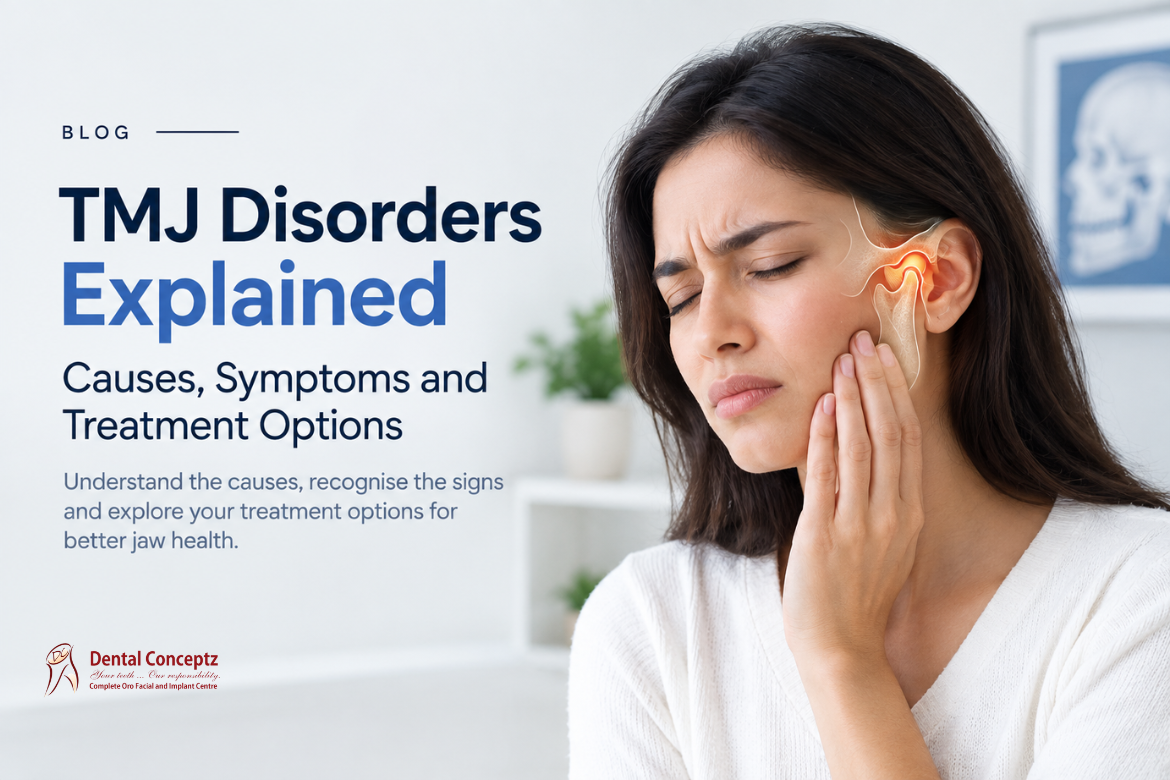
TMJ Disorders Explained: Causes, Symptoms and Treatment Options
There is a type of pain that many people experience for decades without putting a name to it.
- Persistent pain in the jaws
- A clicking sensation while opening the mouth
- Headaches that seem to originate from behind the ears and radiate across the face
- The feeling that the jaws lock while yawning
If any of these sound familiar, you may be experiencing TMJ disorder symptoms without realising that’s what they are or that effective treatment exists.
The temporomandibular joint, the hinge joint that connects your lower jaw to your skull on both sides of your face, is one of the most complex and most frequently used joints in the human body. When it isn’t functioning correctly, the effects extend well beyond the jaw itself into headaches, neck pain, ear symptoms, and a general quality of life impact that patients often can’t easily explain to their doctors.
This blog explains what TMJ disorders are, what causes them, how they present, and what TMJ disorder treatment looks like in 2026.
What Is the Temporomandibular Joint?
Before diving into what goes wrong, it helps to understand what the TMJ actually is and why it’s so uniquely
complex.
The temporomandibular joint is the articulation between the temporal bone of the skull and the mandible, your
lower jaw. You have two of them, one on each side of your face, directly in front of each ear. Together, they
control every movement of your jaw: chewing, speaking, yawning, and swallowing.
What makes this joint unusual and uniquely prone to problems is that, unlike most joints in the body, both sides
must move simultaneously and in a coordinated way. Your left and right TMJs cannot move independently. They work
as a pair, which means a problem on one side almost always affects function on the other.
The joint also contains a small disc of cartilage — called the articular disc — that sits between the joint
surfaces and acts as a cushion during movement. When this disc is displaced from its correct position, it produces
the clicking, popping, or locking symptoms that many TMJ patients experience.
What Causes TMJ Disorders?
TMJ disorders — also called TMDs or temporomandibular disorders — rarely have a single identifiable cause. They
are typically the result of a combination of factors that interact over time.
Bruxism: teeth grinding and clenching. This is one of the most common contributing factors. Bruxism — the
unconscious habit of grinding or clenching the teeth, often during sleep — places enormous and repetitive force on
the TMJ and the surrounding muscles. Over time, this excessive loading damages the joint structures, inflames the
surrounding muscles, and produces the pain, restricted movement, and clicking that characterise TMJ disorders.
Bite problems and malocclusion. When the upper and lower teeth don’t come together correctly — due to
misaligned teeth, missing teeth, or dental restorations that alter the bite — the jaw adapts its movement to
accommodate the misalignment. This adaptive movement places an asymmetric load on the TMJ and eventually produces
symptoms. The relationship between bite alignment and TMJ health is one reason braces treatment in Bangalore is sometimes part of a
comprehensive TMJ management plan — correcting the underlying bite problem to reduce the load on the joint.
Joint structure problems. The articular disc that cushions the joint can become displaced — moving out of
its correct position between the joint surfaces. This disc displacement is responsible for the clicking and
popping sounds that many TMJ patients hear when they open or close their mouth, and in more significant cases for
the locking sensation where the jaw feels unable to open fully.
Muscle hyperactivity and tension. The muscles that control jaw movement — the masseter, temporalis, and
medial pterygoid muscles — can become chronically tense and overactive, particularly in people who clench
habitually. This muscular component of TMJ disorders produces the facial pain, headache, and jaw soreness that
many patients experience, often independently of any structural joint problem.
Stress and psychological factors. Stress is consistently identified as a significant factor in TMJ
disorders — both because stress increases the tendency to clench and grind, and because the perception of pain is
influenced by psychological state. Patients going through periods of high stress often experience worsening TMJ
symptoms, and effective management frequently includes attention to the stress component.
Trauma. A direct impact to the jaw — from a fall, an accident, a blow to the face — can damage the joint
structures and trigger a TMJ disorder that persists long after the obvious injury has healed.
Hypermobility. In some patients, the joints are naturally more mobile than average — the jaw can open wider
than is mechanically ideal, and the disc is prone to displacement because the joint structures are insufficiently
restrained. Hypermobility-related TMJ problems have a different management approach from those caused by
overloading and tension.
TMJ Disorder Symptoms
TMJ disorders present with a remarkable range of symptoms, many of which patients don’t initially connect to their
jaw. This is one of the reasons TMD is frequently misdiagnosed or undiagnosed for extended periods.
Jaw pain and facial pain. Pain in the jaw joint itself, located in front of the ear, on one or both sides,
is the most obvious TMJ symptom. Such pain can either be continuous or periodic, occurring when eating and while
opening the mouth wide, and sometimes can be felt in other areas like cheeks, temples, or ears.
Jaw clicking and pain. The clicking, popping, or crepitus (grinding sound) that occurs when opening or
closing the mouth is one of the most common presentations — and one of the most commonly dismissed. Clicking
without pain may not require immediate treatment, but clicking with pain, or clicking that has progressed to
locking, indicates disc involvement that typically benefits from professional assessment.
Limited jaw opening. An inability to fully open the mouth or deviation to one side during the opening is an
indication that the muscles are not facilitating the joint movement normally. The patient will complain that the
jaw is locked every morning or after meals.
Headaches. TMJ-related headaches are among the most commonly misattributed symptoms. They typically present
in the temples, around the ear, and across the forehead, and are frequently misdiagnosed as tension headaches or
migraines. The distinction matters because the treatment is different — a headache that originates from jaw muscle
tension or joint dysfunction responds to TMJ management rather than migraine medication.
Ear symptoms. Because the TMJ sits immediately adjacent to the ear, problems in the joint commonly produce
ear-related symptoms — aching in the ear, Ear fullness or pressure, tinnitus (ringing in the ear), and
occasionally hearing changes. Many patients see an ENT specialist for these symptoms before a TMJ origin is
identified.
Neck and shoulder pain. The muscles that control jaw position connect to the muscles of the neck and
shoulders through a complex web of anatomical relationships. TMJ muscle dysfunction frequently produces secondary
pain in the neck and upper shoulders — another set of symptoms that patients don’t initially associate with their
jaw.
Tooth pain or sensitivity. In the case of TMD resulting from bruxism, the excessive loading of teeth while
grinding causes pain and sensitivity in the teeth, which may feel like a dental cavity or even a cracked tooth.
The Orofacial Pain Dimension
TMJ headache treatment dentist expertise specifically includes the understanding that TMJ disorders belong within
a broader category called orofacial pain, pain originating in or related to the oral and facial structures.
Orofacial pain is a well-defined specialty within dentistry that not only deals with toothaches but also
TMJ-related problems, neuropathic facial pain, burning mouth syndrome, and the complicated relationship between
dental structures, the temporomandibular joint, and the pain-processing pathways of the nervous system.
The reason this specialty designation matters for patients seeking TMJ treatment is that effective management of
TMJ disorders — particularly complex or chronic cases requires more than a simple bite guard. It requires
expertise in diagnosis, in differentiating between different types of TMJ and orofacial pain, in understanding the
psychological and systemic factors that influence chronic pain, and in coordinating care with other specialists
including neurologists, physiotherapists, and ENT specialists where appropriate.
An orofacial pain specialist with genuine specialty training
in this area brings a level of diagnostic and therapeutic sophistication to TMJ cases that general dental care
does not.
TMJ Treatment Bangalore - The Range of Approaches
TMJ disorder management is not one-size-fits-all. The appropriate treatment depends on the specific diagnosis whether the problem is primarily muscular, primarily disc-related, primarily structural, or a combination — as well as the severity and chronicity of the condition.
- Occlusal splints (bite guards). An occlusal splint is a custom-fitted hard acrylic appliance worn over the teeth — usually at night — that protects the teeth from bruxism-related damage, reduces the load on the TMJ, and repositions the jaw to a more neutral position. It is the most commonly prescribed first-line TMJ treatment and is effective for a significant proportion of patients with muscle-related TMD and mild to moderate disc involvement.
- Physiotherapy and jaw exercises. Guided jaw exercises and physiotherapy — including manual therapy directed at the jaw muscles and joint — are effective for managing the muscular component of TMJ disorders and for restoring normal range of motion after periods of restriction. This is often most effective in combination with an occlusal splint.
- Medication. Anti-inflammatory medications, muscle relaxants, and in some cases low-dose antidepressants (which have evidence for chronic pain management) may be part of a TMJ management plan, particularly for acute flare-ups or chronic pain with a significant central sensitisation component.
- Botulinum toxin (Botox) injections. For patients with significant masseter muscle hypertrophy and persistent clenching that hasn’t responded to other measures, botulinum toxin injections into the masseter muscle reduce the muscle’s force of contraction, providing significant relief from the muscular component of the disorder.
- Bite rehabilitation. When a significant malocclusion is contributing to TMJ dysfunction, dental treatment to correct the bite — through orthodontic treatment, dental restorations, or both — is an important component of long-term management. Treating the joint in isolation while the underlying bite problem persists limits the durability of other interventions.
- Surgical options. For a small proportion of TMJ patients with severe structural joint problems — significant disc displacement that hasn’t responded to conservative management, degenerative joint changes, or joint ankylosis — surgical intervention may be appropriate. Surgical approaches range from minimally invasive arthrocentesis (washing out the joint) to arthroscopy to open joint surgery. These are specialist procedures considered only after conservative management has been thoroughly attempted.
TMJ Jaw Pain Treatment Bangalore
The most important message for anyone experiencing persistent TMJ symptoms is that they don’t improve reliably on their own with time — and the longer the condition goes unaddressed, the more established the pain patterns and joint changes become.
Seeking a professional assessment is appropriate when jaw pain or clicking has been present for more than a few weeks, when jaw opening is limited, or the jaw is locking, when headaches are frequent and haven’t responded to standard headache management, when ear symptoms have been investigated by an ENT without a clear ear cause being found, or when teeth sensitivity or wear is accelerating without an obvious dental cause.
Finding a TMJ Specialist Bangalore With the Right Expertise
At Dental Conceptz, TMJ and orofacial pain specialist expertise is provided through the direct clinical knowledge of Dr. Namratha Umesh — who holds a Fellowship from Roseman University, Utah (USA) specifically in Orofacial Pain and Sleep Medicine, alongside a Master Class in Sleep Medicine from Bengaluru. This specialist credential in orofacial pain — rare in the Indian dental landscape — provides the diagnostic depth and therapeutic range that complex TMJ cases require.
At Dental Conceptz, the TMJ treatment in Bangalore is holistic and includes comprehensive evaluation, imaging where necessary, differential diagnosis of muscle vs. joint problems, and an individualized treatment strategy which may include occlusal splints, referral for physiotherapy, bite analysis, and more. br
With clinics in Sahakaranagar and Jakkur Layout, Dental Conceptz brings specialist orofacial pain expertise to Bangalore patients who have often been managing TMJ symptoms without the right diagnosis or the right specialist for too long.
FAQs
1. What are the most common symptoms of a TMJ disorder?
Common symptoms include jaw pain, clicking or popping, limited jaw movement, headaches, ear pain or fullness, and facial muscle soreness.
2. What causes TMJ disorder?
Common causes include teeth grinding, clenching, bite problems, disc displacement, muscle tension, stress, jaw trauma, and joint hypermobility.
3. Can TMJ disorder cause headaches?
Yes. TMJ disorders can cause headaches around the temples, ears, and forehead due to jaw muscle tension or referred pain.
4. Is jaw clicking a sign of TMJ disorder?
Jaw clicking can indicate disc displacement. Clicking without pain may only need monitoring, while painful clicking or jaw locking should be assessed.
5. How is TMJ disorder treated?
Treatment may include occlusal splints, physiotherapy, jaw exercises, medication, stress management, and, in some cases, injections, dental treatment, or surgery.
6. Can TMJ disorder affect the ears?
Yes. TMJ problems may cause ear pain, fullness, tinnitus, and sometimes hearing changes.
7. How long does TMJ disorder treatment take?
Treatment time varies by the condition and severity. Some cases improve within weeks or months, while chronic conditions may need longer-term management.
8. Where can I find a TMJ specialist in Bangalore?
Dental Conceptz in Sahakaranagar and Jakkur Layout provides TMJ and orofacial pain assessment and treatment under Dr. Namratha Umesh.