
Dental Implants vs Dentures: Which Lasts Longer?
By Dr. Namratha Umesh
Founder – Dental Conceptz
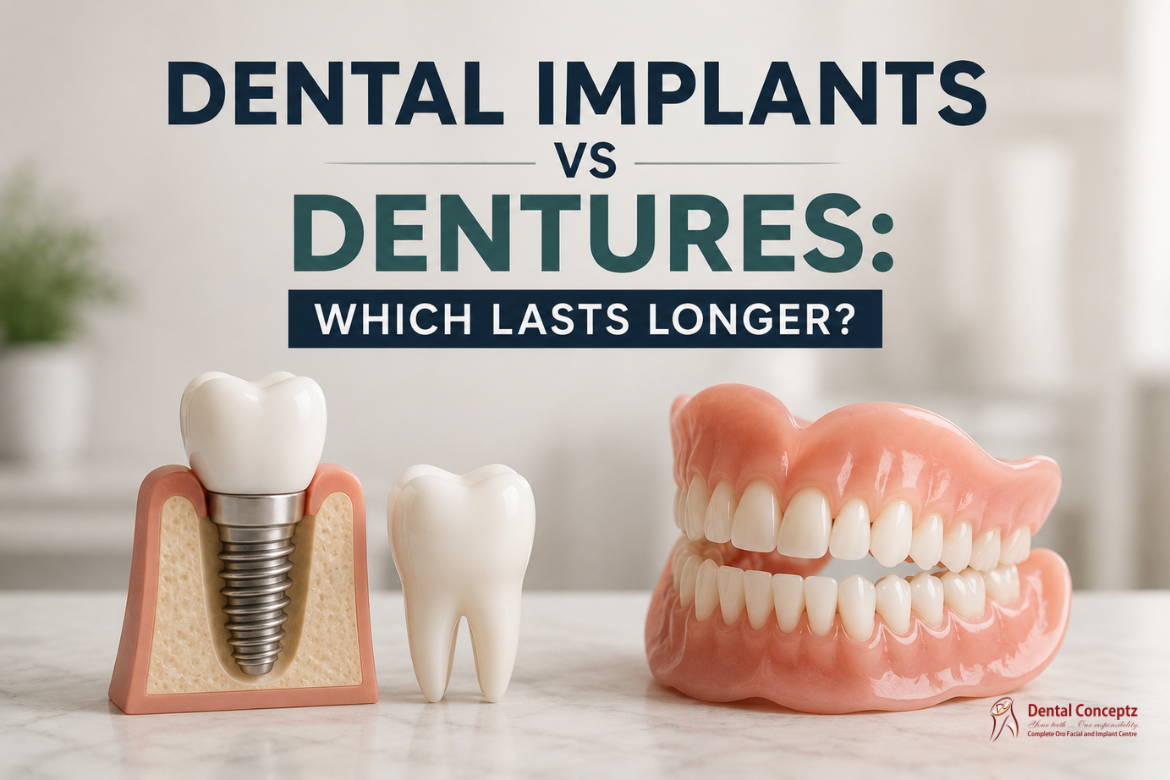
Losing a tooth or several is one of those experiences that quietly changes how you eat, how you speak, how you smile, and ultimately how you feel about yourself in social situations. The decision that follows is one most people aren’t prepared for: what do you replace them with? The dental implants vs dentures, which arise on a daily basis in dental clinics all over Bangalore, is far more complex than any comparison online might lead you to believe. Both are valid options. Both have their benefits and drawbacks. But they are fundamentally different in how they work, how long they last, what they cost over time, and how they affect your daily life. If you’re trying to make this decision, whether for yourself or for a family member, this blog gives you the complete, honest picture.
Understanding What Each Option Actually Is
Before comparing them, it’s worth being clear about what each solution involves, because a lot of misinformation
around this topic comes from people comparing things they don’t fully understand.
Dental implants are titanium posts that are surgically placed into the jawbone, where they integrate with the bone
through a biological process called osseointegration. Once integrated, which takes a few months, a crown, bridge,
or full-arch prosthesis is attached to the implant post. The result is an artificial tooth root that functions,
looks, and feels like a natural tooth. It doesn’t come out. It doesn’t move. It stimulates the jawbone the way a
natural tooth root does, which prevents the bone loss that happens when teeth are missing.
Dentures are a form of removable dental appliance. In the case of full dentures, all missing teeth in one or both
jaw are replaced, while partial dentures involve replacement of few to several missing teeth but not all. This
type of dental appliance fits over the gum line, using pressure, clasps, and adjacent tooth to hold it in place.
They are taken out for cleaning, removed at night, and are not fixed in place.
This fundamental difference — fixed versus removable, bone-integrated versus surface-resting — underlies virtually
every other comparison between the two.
The Longevity Question - Which Actually Lasts Longer?
This is the question that most people come in asking, and it has a clear answer when you look at the clinical
evidence.
Dental implants, when properly placed and maintained, can last a lifetime. The titanium post that goes into
the jawbone — the part that is surgically placed — has a documented lifespan of 25 to 30 years or more, with
studies showing that many implants placed in the 1970s and 1980s are still functioning today. The crown on top of
the implant — the visible artificial tooth — typically lasts 10 to 15 years before it may need to be replaced due
to normal wear, but the implant itself often remains intact indefinitely.
Dentures typically need to be replaced every 5 to 8 years. The reason is dual: the denture itself undergoes
physical wear, and the shape of the jaw beneath it changes over time because of bone resorption. When a tooth root
is absent, the jawbone gradually resorbs — it essentially shrinks because the stimulation that kept it dense is
gone. As the bone changes shape, the denture that was fitted to it no longer fits correctly, causing looseness,
discomfort, difficulty eating, and a changed facial appearance. Relines and adjustments can extend the fit, but
eventually a new denture is needed.
The longevity comparison stated: implants are a once-in-a-lifetime investment for most patients. Dentures are a
recurring cost that needs renewal multiple times over a lifetime.
Dental Implants vs Dentures Comparison - The Key Differences
Comfort and Daily Function
This is where the experiential difference between the two options is most pronounced and it’s the area that most
denture wearers say they underestimated before choosing dentures.
Implants function like natural teeth. You eat what you want — apples, steak, crunchy foods that many denture
wearers avoid entirely. You speak without any concern about movement. You brush and floss as normal. You forget
they’re there in the way you forget your natural teeth are there during daily life.
Dentures require adjustment — both physically and psychologically. There is an adaptation period during which
speech can be affected. Food choices are modified to avoid dislodging the appliance or biting into things that are
too hard. Some wearers report that despite adhesive, dentures occasionally move when laughing or speaking, which
creates a self-consciousness that affects social confidence. Cleaning involves removal, brushing and soaking in
water.
Bone Health
This is the clinical consideration that dentists consistently emphasise — and the one that has the most
significant long-term health implications.
When a tooth is missing, and nothing replaces the root — as is the case with dentures, which replace the crown but
not the root — the jawbone gradually resorbs. This is not a minor aesthetic issue. Significant bone loss changes
the shape of the face, causes a prematurely aged appearance, makes future dental work more difficult, and can
eventually affect the health of remaining teeth and the jaw joint.
Dental Implant Treatment prevents this entirely. The
titanium post that acts as an artificial root continues to stimulate the bone through the normal biting and
chewing forces it transmits. The bone around an implant maintains its density and structure in a way that the bone
beneath a denture does not.
Appearance and Confidence
Both options can look natural — modern dentures and implant-supported crowns are both made from materials that
closely mimic the appearance of natural teeth. The long-term appearance story, however, is different.
Because implants preserve bone, the facial structure supported by that bone remains stable over time. Because
dentures allow bone resorption, the facial appearance can change gradually — the lower third of the face can take
on a sunken or collapsed appearance, the nose and chin appear closer together, and the face can look older than it
actually is.
Which Is Better: Dental Implants or Dentures
The cost conversation is the one that most often tips people toward dentures initially — and the one that most
often changes when people think through the lifetime picture.
The initial cost of dental implants is more expensive compared to dentures. Dental implants for one tooth will
generally cost between ₹25,000 and ₹80,000 and above, depending on the brand of the implant and the grafting
materials used. Full Mouth Dental Implants, replacing all teeth in an arch — are a significant investment that
varies based on the number of implants required and the prosthetic solution chosen.
Dentures have a lower initial cost — making them the more accessible option for many patients, and a legitimate
choice when budget is the primary consideration.
But the long-term cost analysis looks different. A denture replaced every five to seven years over a thirty-year
period represents significant cumulative expenditure — plus the cost of adhesives, specialist cleaning products,
and periodic relines between replacements. When you calculate the full lifetime cost of dentures versus the
lifetime cost of implants that may never need replacing, the gap narrows considerably for many patients.
Dental implants cost in Bangalore also varies by the experience and qualifications of the implantologist — which
matters significantly for long-term outcomes. An implant placed by a highly trained specialist with advanced
techniques has a demonstrably better long-term prognosis than one placed by a less experienced practitioner.
Dental Implants vs. Bridges
When a single tooth is missing, there’s a third option worth mentioning: the dental bridge. The bridge is fitted
between the natural teeth by attaching it to them and placing the false tooth in between them, creating a
non-surgical treatment method to improve appearance and function.
Bridges are effective and have a lifespan of approximately 10 to 15 years. The consideration worth understanding
is that preparing the adjacent teeth to support the bridge requires removing a portion of healthy tooth structure
— permanently altering teeth that were previously healthy. Implants avoid this by being self-supporting.
For single tooth replacement, most implantologists today recommend an implant over a bridge for patients who are
appropriate candidates — because the implant doesn’t affect adjacent teeth and addresses the bone loss issue that
a bridge does not.
Dentures vs Implants: Which Is Better
Neither option is universally right for every patient. Here’s an honest guide to which solution tends to suit
which situations better.
Dental implants tend to be the better choice when the patient is in good general health, has adequate bone density
to support implant placement or is a candidate for bone grafting, is looking for a permanent long-term solution,
prioritises comfort and natural function in daily life, and wants to prevent the bone loss and facial changes
associated with tooth loss.
Dentures tend to be the more appropriate choice when significant bone loss has already occurred. Implants require
extensive grafting when systemic health conditions affect healing and implant success rates, when upfront cost is
a primary limitation, or when the patient is very elderly. The surgical element of implant placement is a concern.
Many patients today opt for implant-supported dentures — a hybrid solution where two to four implants are placed
to provide anchor points for a removable denture. This option improves denture stability significantly while being
more affordable than full individual implants for each tooth.
Finding the Right Implant Dentist Bangalore
The outcome of dental implant treatment depends significantly on the skill and training of the implantologist.
Implant placement is a surgical procedure that requires precise placement into the correct position, appropriate
depth, and correct angulation — and experience matters enormously.
At Dental Conceptz, with clinics in Sahakaranagar and Jakkur Layout, dental implant treatment is led by Dr.
Namratha Umesh — an MDS Prosthodontist and Implantologist with over 5,000 successful implantations completed. Dr.
Namratha has trained personally with Dr. Paulo Malo — the clinician who developed the ALL-ON-4 implant protocol
and holds advanced implant training from Switzerland, Germany, Spain, Poland, and Brazil.
As the leading Dental Clinic in Sahakaranagar and Jakkur for implant
treatment, Dental Conceptz brings international-standard implant expertise directly to Bangalore patients —
including digital planning, advanced bone management techniques, and the full range of implant-supported solutions
from single tooth replacement to complete arch reconstruction.
When people are looking for implants in Bangalore, they should visit Dental Conceptz for a detailed clinical
examination, X-rays, a discussion on all possible treatment options, and an honest opinion regarding whether
implants, dentures, or a combination of both would be the best choice for their needs.
As a trusted Dental Clinic in Bangalore with over 24 years of clinical experience and 10,000+ happy patients,
Dental Conceptz approaches every patient’s missing tooth situation with the understanding that the right answer is
always the one that serves that specific patient’s long-term health and wellbeing — not the most expensive or the
most complex option available.
FAQs
1. Which lasts longer dental implants or dentures?
Dental implants can last 25 years or more with proper care, while dentures usually need replacement every 5–8 years.
2. Are dental implants better than dentures?
For many patients, implants offer better comfort, stability, and chewing ability while helping preserve jawbone health.
3. What are the disadvantages of dentures?
Dentures can become loose over time, need regular replacement, and may limit certain foods.
4. How much do dental implants cost in Bangalore?
The cost depends on the number of implants and your treatment plan. A consultation provides an accurate estimate.
5. Can dentures be replaced with dental implants later?
Yes. Many denture wearers can switch to implants, depending on their jawbone condition.
6. What is the success rate of dental implants?
Dental implants have a success rate of around 95–98% when placed by an experienced implantologist.
7. Are dental implants painful?
The procedure is done under local anaesthesia. Mild soreness after treatment is normal and usually settles within a few days.
8. Where can I get dental implants in Bangalore?
Dental Conceptz in Sahakaranagar and Jakkur offers dental implant treatment by Dr. Namratha Umesh, an experienced Prosthodontist and Implantologist.