
Invisalign vs Braces: Cost, Results, Pain and Which Is Better for Adults?
By Dr. Namratha Umesh
Founder – Dental Conceptz
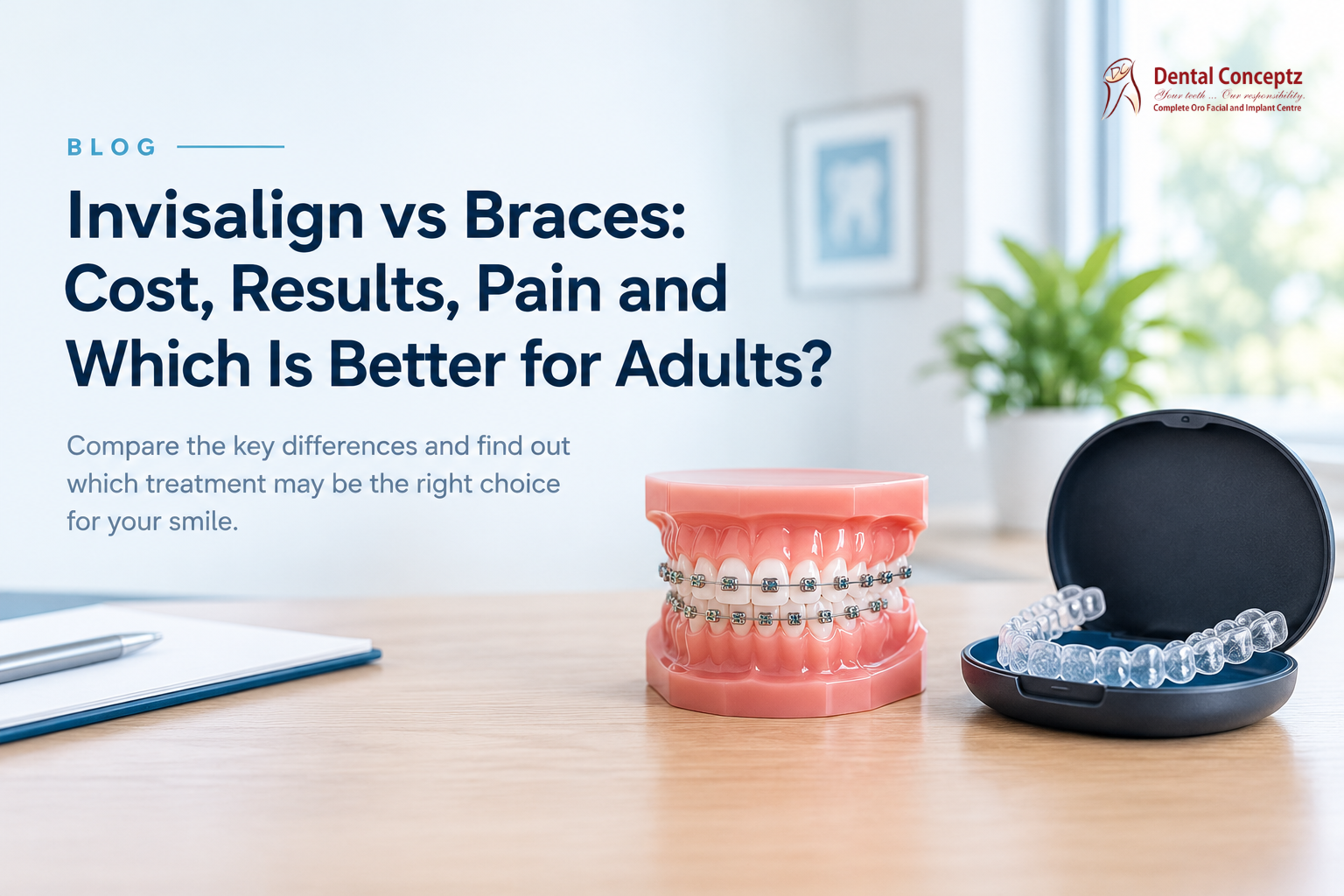
The decision to straighten your teeth as an adult is one that more and more people in Bangalore are making, and it’s a decision that immediately raises a second, more complicated question. The Invisalign vs braces comparison is one of the most searched dental topics in India right now, and for good reason. Both options have become significantly better in recent years. Both can deliver excellent results. But they are genuinely different in how they feel, how they look, how they work, and what they cost, and the right choice for one person is often not the right choice for another. No matter whether you have been thinking about Invisalign vs braces for adults for quite some time now and need a thorough comparison between the two, or have only just begun researching them and found them confusing, this blog post provides you with everything you need to know, in its entirety.
What You’re Actually Comparing
Before we get to the details, let us first explain what each choice entails.
Conventional braces involve metal or ceramic brackets that are attached to the exterior surfaces of the teeth,
linked by a wire that exerts a controlled amount of force in order to slowly move the teeth into their proper
alignment. The orthodontist tightens the wire every four to six weeks, depending on the rate of tooth movement.
The braces remain fixed throughout the course of treatment and cannot be removed by the patient.
Invisalign is a clear aligner system, a series of custom-made, virtually invisible plastic trays that fit over the
teeth and exert controlled pressure to move them progressively. Each set of aligners is worn for approximately one
to two weeks before being replaced with the next set in the series. Aligners are removable; they’re taken out to
eat, drink anything other than water, and for brushing and flossing.
These two fundamental differences fixed versus removable, and visible versus nearly invisible drive most of the
practical differences between the two options in daily life.
Appearance
For most adults considering orthodontic treatment, the appearance question is the first one. Wearing visible metal
brackets and wires as an adult feels different from wearing them as a teenager and for many adults in professional
or social-facing roles, it genuinely matters.
Invisalign vs traditional braces on the visibility dimension is relatively straightforward. Invisalign aligners
are made from a clear, smooth plastic that is very difficult to see from normal conversational distance. Most
wearers report that colleagues and acquaintances don’t notice the aligners at all during normal interaction. For
adults who want to straighten their teeth without advertising the fact, this is a significant advantage.
Ceramic braces — a variation on traditional braces that uses tooth-coloured or clear ceramic brackets instead of
metal — partially close this gap. From a distance, ceramic braces are significantly less visible than metal
braces. Up close or in photographs, the brackets and wires are still visible. They represent a middle ground
between the clear aesthetics of Invisalign and the full visibility of metal braces.
Metal braces are the most visible option — and for adults with significant professional or social concerns about
appearance during treatment, this is genuinely a limiting factor.
Comfort and Pain
Both treatment options involve discomfort — because both work by applying force to move teeth, and tooth movement
involves pressure that the mouth registers as sensitivity and soreness. The character of that discomfort differs
between the two.
Braces discomfort tends to be most significant in the first week of treatment and for a day or two after
each adjustment appointment when the wire is tightened. Between adjustments, many patients adapt and experience
only mild background awareness of the appliance. The brackets themselves can irritate the inner surfaces of the
lips and cheeks, particularly in the early weeks before the soft tissue toughens. Orthodontic wax applied over
irritating brackets provides temporary relief.
Invisalign discomfort is typically experienced as pressure in the first two to three days of wearing each
new set of aligners — the period when the new aligner is working to move the teeth into the next position. This
pressure-soreness subsides as the teeth accommodate the aligner. Many patients describe Invisalign discomfort as
manageable with standard pain relief if needed in the first day or two of each new tray. The smooth plastic
surface causes significantly less soft tissue irritation than braces brackets.
The comparative discomfort assessment most patients and practitioners offer is that Invisalign produces more
predictable, lower-intensity discomfort that is concentrated in short windows — while braces produce more variable
discomfort with occasional peaks after adjustments.
Invisalign Cost Bangalore vs Braces Cost Bangalore
In adults, cost plays a critical role in orthodontic treatments, and cost comparison between the two procedures in
Bangalore in 2026 holds considerable significance.
Braces cost in Bangalore varies depending on the type:
Metal braces are the most affordable option, typically ranging from approximately ₹25,000 to ₹50,000 for a full
treatment course, depending on the complexity of the case and the duration of treatment.
Ceramic braces, the tooth-coloured alternative, typically range from ₹40,000 to ₹70,000 or more, reflecting the
higher material cost of the ceramic brackets.
Costs of Invisalign in Bangalore are higher compared to conventional braces. The cost of full Invisalign in
Bangalore in 2026 usually varies between about ₹1,50,000 and ₹3,50,000, depending on the complexity of the case
and the number of aligners needed. Invisalign Lite, which is a reduced treatment period for minor crowding or
spacing cases, will cost less than Invisalign Comprehensive.
The price gap is substantial and very real. In cases of adult patients who have limited budgets, braces,
especially metal braces, will continue to be a more economical route to achieve the same orthodontic outcome.
What makes the simple cost analysis difficult is the complete value proposition. The patient with Invisalign does
not have to deal with brackets causing irritation in the soft tissue, does not have food restrictions, maintains
good dental hygiene, and has a more discreet treatment process. Whether these benefits make up for the extra cost
is an individual decision.
Treatment Duration
Treatment duration for both options depends primarily on the complexity of the individual case, how much tooth
movement is required, in which direction, and how much space exists to work with.
As a general comparison, traditional braces typically treat most cases in twelve to twenty-four months. Invisalign
treatment duration for comparable cases is broadly similar — twelve to eighteen months for many cases, with
complex cases potentially similar to braces timelines.
The important caveat for Invisalign treatment
duration is compliance. Aligners must be worn for twenty to twenty-two hours per day to achieve the
predicted tooth movements on schedule. Patients who wear their aligners inconsistently removing them for extended
periods beyond meals and oral hygiene extend their treatment timeline significantly. A key difference from braces:
braces work continuously because they can’t be removed. Invisalign’s timeline depends on the patient’s discipline
in wearing the aligners as directed.
Suitability - Which Cases Work Better With Each Option?
Invisalign treatment in Bangalore is highly effective for a wide
range of orthodontic presentations, mild to moderate crowding, spacing, and many bite corrections. The technology
has advanced significantly, and many cases that would previously have been considered braces-only are now
successfully treated with Invisalign by an experienced provider.
However, there are case types where traditional braces remain the more effective option:
- Very severe crowding or rotation where the degree of movement required exceeds what aligners can achieve predictably.
- Significant vertical movement of teeth: aligners are less effective than braces for certain vertical tooth position corrections.
- Cases requiring specific three-dimensional tooth movement that braces handle more efficiently.
- Some complex bite corrections ,particularly severe overbites, underbites, or crossbites ,require significant jaw-level correction in conjunction with tooth movement.
The clinical assessment of whether your specific case is suitable for Invisalign requires examination and diagnostic records — not a self-assessment based on general descriptions. An orthodontist who provides both options and is genuinely familiar with the limitations of aligners for specific presentations will give you an honest assessment of which option suits your particular teeth.
Invisalign vs Braces for Adults
For adults specifically, the lifestyle implications of each option are often as important as the clinical
considerations.
Food and drink. With braces, hard, sticky, and crunchy foods must be avoided throughout treatment to protect
the brackets and wires. Invisalign has no food restrictions — aligners are removed to eat, so no modification of
diet is required.
Oral hygiene. Braces make thorough oral hygiene more demanding — cleaning around brackets and wires
requires dedicated technique and sometimes specialist tools. The consequence of poor oral hygiene during braces
treatment can include white spot lesions (permanent marks on enamel) and gum inflammation. Invisalign aligners are
removed for brushing and flossing, allowing completely normal oral hygiene technique.
Social and professional situations. Aligners can be removed for short periods for a formal photograph, a
significant presentation, or a special occasion. Braces cannot.
Sports and physical activity. Braces can cause soft tissue injury in contact sports when the inner surface
of the lip impacts the brackets. Invisalign aligners are smooth and lower-risk in this context, though a sports
mouthguard is still appropriate for significant contact activities.
Emergency appointments. A break in the bracket or wire of the braces is something that needs a visit to the
dentist for repair, and during that time, there may be no movement of the tooth, increasing the treatment
duration. Problems with aligners can be comparatively less troublesome.
Finding the Right Invisalign Dentist and Orthodontist in Bangalore
The quality of orthodontic treatment, whether with Invisalign or braces, depends significantly on the expertise and experience of the practitioner. Invisalign specifically has a certification and experience tier system — Invisalign providers with higher case volume and completion rates have access to additional treatment capabilities and have more experience managing the nuances that arise in complex aligner treatment. At Dental Conceptz, orthodontic treatment in Jakkur and Sahakaranagar is provided by Dr. Karan Ganapathi, an MDS Orthodontist who specialises specifically in orthodontic diagnosis and treatment. Invisalign treatment in Sahakaranagar, Bangalore, at Dental Conceptz is delivered within the broader specialist clinic context led by Dr. Namratha Umesh — an internationally trained prosthodontist with 24+ years of clinical experience — ensuring that orthodontic treatment is planned with awareness of the patient’s complete dental health picture. A consultation regarding orthodontic treatment with Dental Conceptz will entail a clinical exam followed by an exploration of two treatment options, namely Invisalign and braces, along with an accurate assessment of which will suit your situation best, followed by an open costing of each treatment, making it possible for you to make an educated choice. The right choice between Invisalign and braces is always specific to the individual — the case complexity, the lifestyle priorities, the budget, and the specific outcome desired. Understanding both options clearly is the first step. A clinical consultation with a qualified orthodontist is the second.
FAQs
1. Is Invisalign better than braces for adults?
It depends on the case and personal priorities. Invisalign is discreet, removable, and easier for eating and cleaning, while braces can be more suitable for complex cases and are often more affordable.
2. How much does Invisalign cost in Bangalore in 2026?
Invisalign typically costs around ₹1,50,000–₹3,50,000 or more, depending on case complexity and the number of aligners required. A consultation provides a more accurate cost estimate
3. Is Invisalign painful?
Most patients experience mild pressure or discomfort for the first few days with a new aligner. It usually settles as the teeth adjust.
4. Can Invisalign fix all dental alignment problems?
Invisalign can treat many crowding, spacing, and bite issues. Severe or complex cases may be better suited to traditional braces after an orthodontic assessment.
5. How long does Invisalign treatment take compared to braces?
Treatment often takes around 12–18 months for both, depending on the case. Invisalign requires wearing aligners for about 20–22 hours daily to stay on schedule.
6. What are the disadvantages of Invisalign compared to braces?
Invisalign generally costs more, requires consistent wear, can be lost or damaged, and may not suit some complex cases. Aligners also need to be removed while eating.
7. Do braces or Invisalign give better results?
Both can provide good results when properly suited to the case. The choice depends on the alignment problem, treatment needs, and orthodontist's assessment.
8. Where can I get Invisalign or braces treatment in Bangalore?
Dental Conceptz in Sahakaranagar and Jakkur Layout offers Invisalign and traditional braces treatment with orthodontic care from Dr. Karan Ganapathi.